
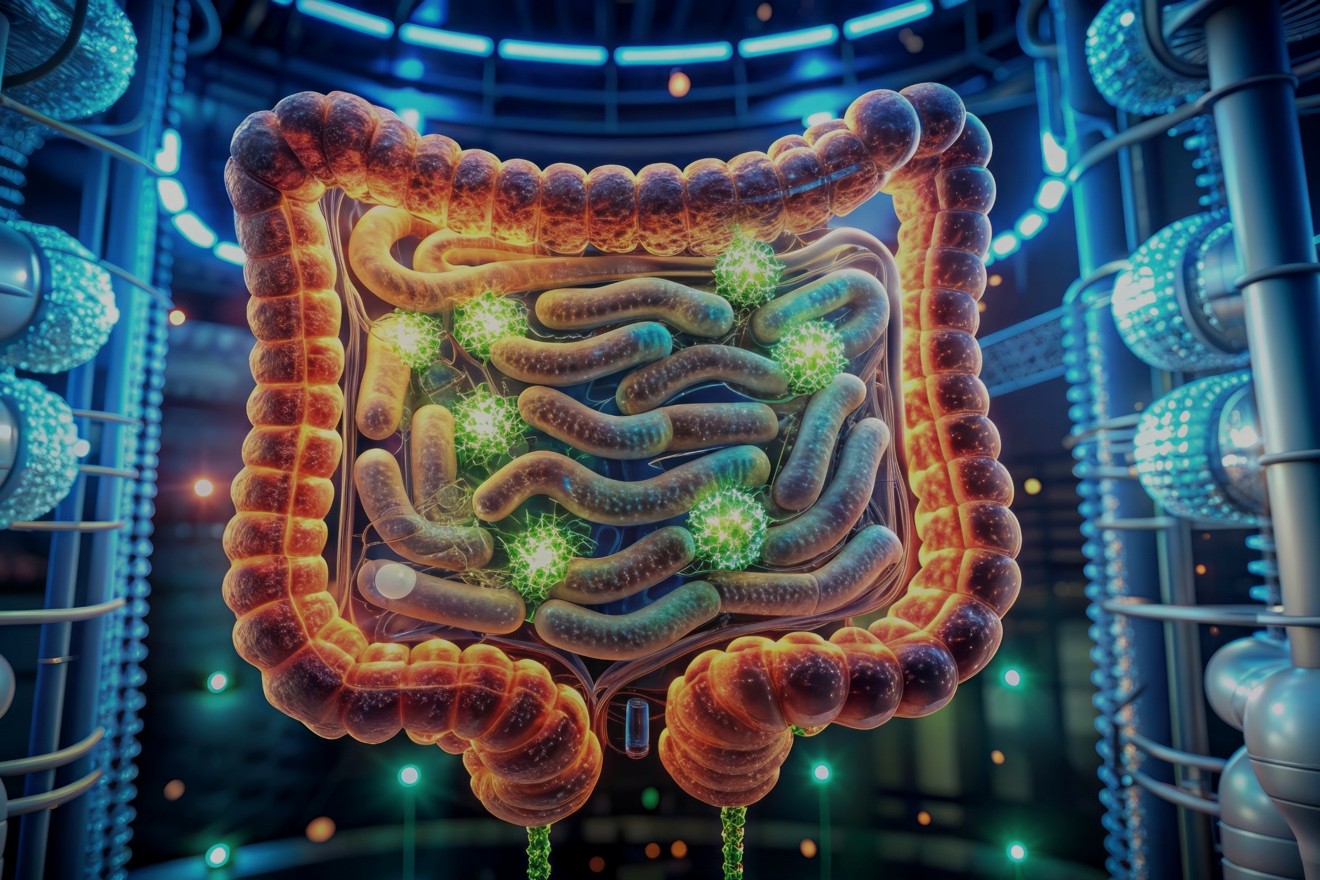
A stylised illustration of the human intestines glowing warm against deep blue, with bright green gut microbes among the coils

Nutrition, individualised

Foundational Nutrition & Microbiome Science

We do not prescribe diets. We add a key pillar to your healthspan — a nutritional foundation built for your biology, not borrowed from a trend.

Good nutrition is the foundation for total health — and plays an instrumental role in the lymphatic system, the gut, the immune system, and the brain.

A targeted, individually built nutrition strategy can add up to 25 percent to your healthspan.

“Ninety percent of all chronic disease has a root in poor nutrition. Our practice aims to fix that.”

Three functions, central to every health plan — fuel, repair, and immune regulation.

  • Fuel

    Metabolic science is governed by the interplay of cellular efficiency, hormonal signalling, and evolutionary adaptation. A nuanced metabolism is dialled in on that interplay — as it relates to you, the individual. Food is more than fuel. Broken down in the gut, it is the maestro that conducts the dance between all your bodily systems.

  • Repair

    Repair is constant, not occasional. Your body renews and rebuilds itself daily, and nutrition provides the building blocks. We build them into every plan, at the level your body needs now.

  • Immune regulation

    The gut is the body’s largest immune interface. Its microbial composition directly modulates immune tolerance, inflammation, and resilience — which is why every plan in this practice begins with the gut.

The microbiome — your body’s operating layer

Trillions of organisms, running more than digestion. Your gut hosts a bacterial ecosystem that regulates immunity, inflammation, neurotransmitter production, and metabolic signalling. It influences how you absorb nutrients, how you respond to stress, and how you age.

Disruption is the common thread. Antibiotics, ultra-processed food, chronic stress, microplastics and environmental toxins degrade microbial diversity — and with it, resilience. This is a root cause hiding in plain sight.

Nutrition in this practice is not a meal plan. It is built individually, adapted as a key part of your treatment plan — not an add-on.

Diets solve the wrong problem

Keto, carnivore, intermittent fasting — each has a mechanism, and each works for a subset of the population. But none of them is a foundation. Diets are built for populations. Your biology is individual.

Foundational nutrition is different. It starts with testing — your microbiome, your metabolic markers, your nutrient status — and builds from what your body actually needs.

Foundational nutrition is built around you, not around a trend.

Where foundational nutrition matters most

Performance — athletes & high achievers

The performance gut is real. Elite athletes carry distinct microbial profiles — specific genera that convert exercise-derived lactate into propionate, a short-chain fatty acid linked to endurance. Microbiome composition is now a performance variable.

For executives and high-performing patients, the same principle applies — cognitive endurance, stress resilience, and recovery all track back to gut health and metabolic stability.

Metabolic programs

Metabolic health is more than weight. We build metabolic programs around body composition, inflammatory load, glucose regulation, and long-term metabolic flexibility — not just the number on the scale.

Whether pharmaceutical intervention is part of the picture or not, the nutritional foundation is the same: protect muscle, stabilise blood sugar, reduce inflammation, and build habits that last beyond any single intervention.

Cancer care & immunotherapy

Nutritional status predicts immunotherapy response. Poor nutrition, sarcopenia and low skeletal muscle mass are now associated with reduced survival and poorer treatment response in cancer patients. Nutrition is no longer a supportive afterthought — it is a determinant of outcome.

Nutrition is part of your cancer treatment — supporting immune surveillance, maintaining body composition, and optimising the gut environment that shapes how immunotherapy works.

Autoimmune disease

The gut barrier is where autoimmunity begins. Intestinal permeability — driven by microbial dysbiosis, dietary triggers and inflammatory signalling — allows microbial products to translocate across the barrier, priming the immune system against its own tissues. This mechanism has been documented in rheumatoid arthritis, inflammatory bowel disease, celiac disease, type 1 diabetes and psoriasis, among others.

Restoring barrier function, reducing inflammatory load and supporting immune regulation from its source is central to how we approach autoimmune care — and nutrition is the driver of that work.

Pre- & post-surgical recovery

Surgery disrupts the gut. Anaesthesia, antibiotics, surgical stress and fasting all degrade the microbiome — at the exact time the body needs immune surveillance and tissue repair working at full capacity. Emerging prehabilitation research demonstrates that optimising gut microbiota before surgery reduces surgical site infections, shortens recovery and improves outcomes.

We begin weeks before a procedure — assessing the gut environment, correcting deficiencies, and building metabolic reserves — then continue targeted nutrition through recovery to accelerate healing, reduce complications, and restore function.

Dementia & neurodegeneration

The gut-brain axis is a clinical pathway. Gut microbiome disruption is linked to the neuroinflammation, amyloid accumulation, and metabolic dysfunction that characterise Alzheimer’s disease and age-related cognitive decline. Dietary modification — including targeted Mediterranean-ketogenic protocols — has been shown to induce measurable shifts in the gut microbiome and brain metabolites, with neuroprotective effects that are genotype- and sex-dependent.

We assess cognitive risk alongside microbiome and metabolic data, then build nutritional strategies that target the gut-brain axis directly — as part of our Brain Lab programs and long-term neurocognitive care.

Selected references: Bautista J, et al. The human microbiome in clinical translation: from bench to bedside. Frontiers in Microbiology. 2025. · Mattavelli E, et al. Nutritional status, immunonutrition, and gut microbiome: a coming of age for immunotherapy? Frontiers in Immunology. 2025. · Carlone J, Parisi A, Fasano A. The performance gut: a key to optimizing performance in high-level athletes. Frontiers in Sports and Active Living. 2025. · Łoniewski I, et al. Microbiota modifications in prehabilitation — the next step towards comprehensive preparation for surgery. Gastroenterology Review. 2024. · Park G, et al. A modified Mediterranean-style diet enhances brain function via specific gut-microbiome-brain mechanisms. Gut Microbes. 2024. · Nguyen N-TA, Jiang Y, McQuade JL. Eating away cancer: the potential of diet and the microbiome for shaping immunotherapy outcome. Frontiers in Immunology. 2024. · Abeltino A, et al. Unraveling the gut microbiota: implications for precision nutrition and personalized medicine. Nutrients. 2024. · Fu T. Diet conditions the gut microbiome for cancer immunotherapy. The Innovation Nutrition. 2026. · Ivanich K, et al. Ketogenic diet modulates gut microbiome-brain metabolite axis in APOE4 mice. Journal of Neurochemistry. 2025. · Farahani AF. Dietary patterns and gut microbiome modulation in cancer immunotherapy. Preprints.org. 2025. · Lisowski C, et al. The role of gut microbiota support in the prehabilitation process for patients requiring gastrointestinal surgery. Medical Studies. 2025.

You cannot copy content of this page